Introductio
There’s something quietly powerful about logarithmic thinking. At first glance, it feels abstract—something tucked away in a math textbook—but once you recognize it in the world around you, you begin to see it everywhere. From measuring earthquakes to calculating investment returns, logarithmic patterns shape the way we interpret growth, scale, and change.
If you’ve ever wondered why the Richter scale jumps dramatically with each number, or how compound interest multiplies wealth over time, you’ve already brushed against logarithmic ideas. This concept matters because it gives us a way to understand phenomena that grow too fast—or shrink too slowly—for ordinary linear thinking to make sense.
In this guide, we’ll unpack what logarithmic really means, how it works, and why it’s one of the most practical tools in mathematics and science. No intimidating jargon—just clear explanations and real-world relevance.
Understanding Logarithmic Foundations
At its core, a logarithm answers a simple question:
To what power must a number be raised to produce another number?
That’s it.
If exponential growth tells you the result of repeated multiplication, logarithms tell you how many times multiplication happened.
The Relationship Between Exponents and Logarithms
If:103=1000
Then:log10(1000)=3
The exponential form shows growth.
The logarithmic form reveals the exponent behind that growth.
This inverse relationship is what makes the concept so powerful. It helps reverse engineer rapid changes.
Why Linear Thinking Fails for Big Growth
Linear growth increases by addition.
Exponential growth increases by multiplication.
And logarithmic analysis helps decode exponential growth.
Here’s the difference:
- Linear: 2, 4, 6, 8, 10
- Exponential: 2, 4, 8, 16, 32
The second pattern explodes quickly. That’s why we need a different mathematical lens to interpret it.


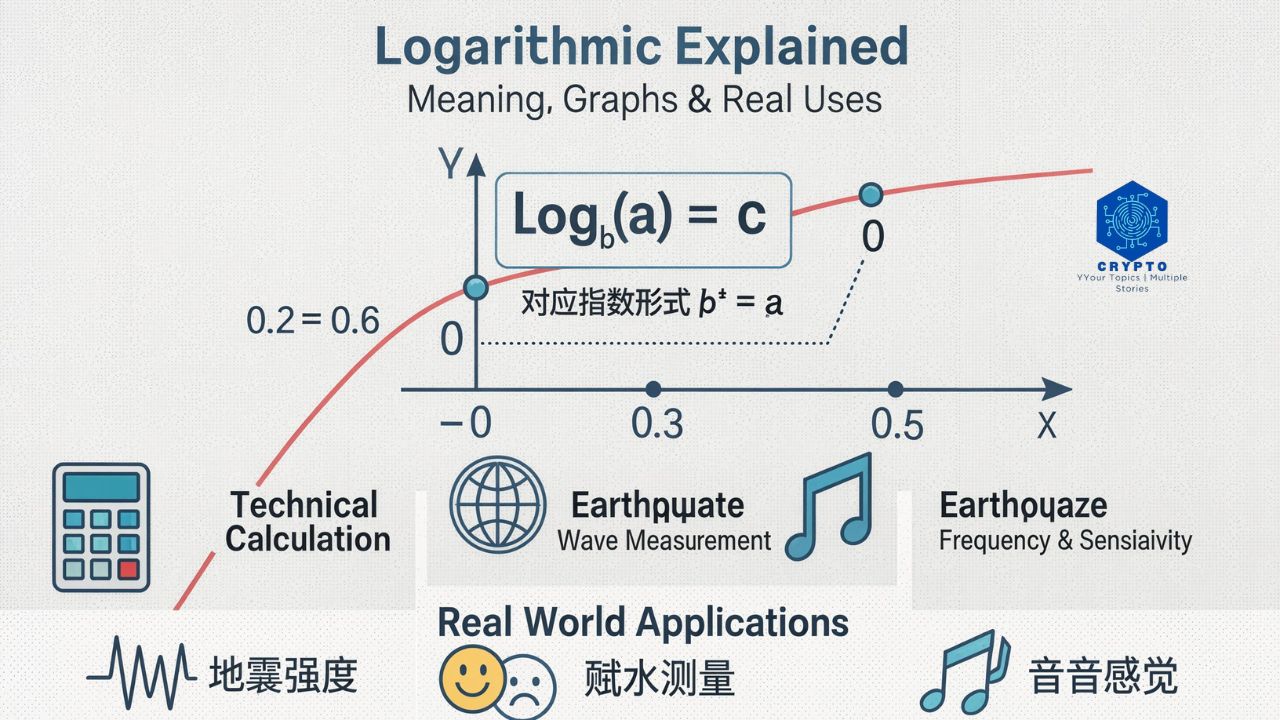
When visualized, exponential curves shoot upward sharply. Logarithmic curves, on the other hand, rise quickly at first and then gradually level off
This leveling effect is essential in modeling real-world limits—like population growth or learning curves.
The Meaning of Logarithmic in Practical Terms
When something is described as logarithmic, it usually means:
- Growth slows down over time.
- Each equal step represents multiplication rather than addition.
- Early changes matter more than later ones.
Let’s explore real examples.
Sound Intensity and Decibels
The decibel scale is logarithmic. That means:
- A 20-decibel sound is not twice as loud as 10 decibels.
- It’s 10 times more intense.
Each 10-unit increase multiplies sound intensity by 10.
Without logarithms, describing sound intensity would involve astronomically large numbers.
Earthquakes and the Richter Scale
The Richter scale works the same way.
- A magnitude 6 earthquake is 10 times stronger than magnitude 5.
- A magnitude 7 is 100 times stronger than magnitude 5.
The logarithmic structure compresses massive energy differences into manageable numbers.
The pH Scale in Chemistry
The pH scale measures acidity.
- pH 3 is 10 times more acidic than pH 4.
- pH 2 is 100 times more acidic than pH 4.
This scaling method makes extreme chemical variations understandable.


4
Notice a pattern? In each case, equal steps represent multiplication, not addition.
Logarithmic Growth vs Exponential Growth
These two concepts are connected—but they behave very differently.
Exponential Growth
- Starts slowly
- Accelerates dramatically
- Often associated with population growth, viruses, or compound interest
Formula form:y=a⋅bx
Logarithmic Growth
- Starts rapidly
- Slows down over time
- Often seen in learning curves or diminishing returns
Formula form:y=log(x)
Exponential growth describes explosive expansion.
Logarithmic growth describes rapid early gains followed by stability.
Logarithmic Scales in Data Visualization
Why do scientists and analysts use logarithmic scales in graphs?
Because some datasets span enormous ranges.
Imagine plotting:
- 10
- 1,000
- 100,000
- 10,000,000
On a normal scale, smaller values become invisible.
On a logarithmic axis:
- Each step increases by a factor of 10.
- Data becomes visually balanced.
This makes it easier to interpret:
- Economic data
- Epidemiological spread
- Financial returns
- Scientific measurements
Logarithmic Thinking in Finance
Compound interest is a classic example.
Suppose you invest money at 8% annual growth. The increase isn’t linear. It compounds.
Over time, returns grow exponentially.
To calculate how long it takes for money to double, logarithmic equations are used:t=log(1+r)log(2)
Where:
- r = interest rate
- t = time
This calculation helps investors predict future outcomes accurately.


Notice how early growth looks modest, but later accelerates dramatically.
Understanding this helps prevent financial short-sightedness.
The Role of Logarithmic Functions in Technology
In computer science, logarithms appear constantly.
Algorithm Efficiency
Search algorithms like binary search operate in logarithmic time complexity:O(logn)
This means:
- If you double the dataset size,
- Processing time increases slightly—not dramatically.
That efficiency powers:
- Databases
- Search engines
- Sorting systems
Data Compression
Large datasets are often compressed using techniques that rely on logarithmic encoding principles.
This allows:
- Faster transmission
- Lower storage costs
- Efficient retrieval
Modern computing would struggle without these principles.
Logarithmic Patterns in Nature
The natural world embraces logarithmic behavior.
Human Perception
Our senses often respond logarithmically:
- Brightness perception
- Sound intensity perception
- Even taste sensitivity
This allows humans to detect a wide range of intensities without being overwhelmed.
Biological Growth
Certain biological processes show rapid early growth followed by leveling off:
- Learning new skills
- Muscle growth
- Neural adaptation
These follow a logarithmic pattern—fast initial gains, slower long-term progress.
How to Solve Logarithmic Equations
Let’s simplify the process.
Step 1: Convert to Exponential Form
If:log10(x)=3
Then:x=103
So:x=1000
Step 2: Use Log Rules
Three essential rules:
- Product Rule log(a⋅b)=loga+logb
- Quotient Rule log(a/b)=loga−logb
- Power Rule log(an)=nloga
These allow complex equations to simplify into manageable pieces.
Common Misconceptions
Let’s clear up confusion.
- Logarithmic does not mean “slow growth.”
- It doesn’t mean “tiny numbers.”
- It’s not just a calculator function.
It’s a structural way of interpreting multiplicative relationships.
Understanding that shift changes how you view data.
FAQ Section
FAQs
What does logarithmic mean in simple words?
It describes a relationship where equal steps represent multiplication instead of addition. It’s the inverse of exponential growth.
Where is logarithmic used in real life?
It appears in earthquake measurement, sound intensity, acidity levels, financial modeling, and computer science algorithms.
Is logarithmic growth faster than exponential growth?
No. Exponential growth accelerates continuously. Logarithmic growth slows down over time.
Why are logarithmic scales useful?
They compress very large ranges of numbers into manageable formats, making data easier to analyze and visualize.
Are logarithms difficult to learn?
They seem complex at first, but once you understand the exponent relationship, they become straightforward.
How does logarithmic relate to compound interest?
It helps calculate how long investments take to double or reach specific targets under exponential growth.
Why do our senses respond logarithmically?
It allows humans to perceive wide intensity ranges efficiently without overload.
Conclusion
When you step back and observe the world through a logarithmic lens, patterns emerge that linear thinking simply can’t explain. It becomes clear why scientists use logarithmic scales to measure massive forces, why economists rely on logarithmic models to forecast growth, and why engineers design systems around logarithmic efficiency.
This concept is not just a mathematical curiosity—it’s a framework for understanding acceleration, compression, perception, and scale. Once you grasp how logarithmic relationships work, complex phenomena begin to feel manageable.
And perhaps that’s the real power here: clarity in the face of overwhelming growth.