
Introduction
There’s a moment in every gym-goer’s journey when lifting weight overhead stops feeling simple and starts feeling serious. The overhead press is one of those exercises that looks straightforward but quickly humbles you once the bar leaves your shoulders.
Unlike flashy isolation movements, the overhead press demands full-body coordination, patience, and respect for proper mechanics. It builds not just strong shoulders, but confidence—because few movements test raw, honest strength quite like pressing weight overhead.
Whether your goal is muscle growth, athletic power, or long-term joint health, understanding how to perform this lift correctly can change how your entire upper body develops.
Table of Contents
- What the overhead press really is
- Muscles worked and why it matters
- Proper form step by step
- Common mistakes and how to fix them
- Variations for different goals
- Programming and progression
- Safety, mobility, and recovery
- FAQs
- Conclusion
What the overhead press really is
The overhead press is a compound strength exercise where weight is pressed vertically from shoulder height to a locked-out position overhead. It can be performed with a barbell, dumbbells, kettlebells, or machines, but the free-weight version remains the gold standard.
What makes this movement special is how unforgiving it is. There’s no bench to support you and no momentum to hide behind. Every rep demands balance, core stability, shoulder mobility, and precise timing.
In reality, this lift is less about just shoulders and more about how well your body works as one unit.
Muscles worked and why it matters
Understanding muscle involvement helps explain why progress on this lift often feels slower—but more rewarding.
Primary muscles activated
- Anterior and medial deltoids
- Triceps brachii
- Upper chest (clavicular head)
Secondary and stabilizing muscles
- Core musculature (especially obliques and transverse abdominis)
- Upper back and traps
- Glutes and quads for stabilization
Because so many muscles are involved, the overhead press delivers a high return on effort. Studies on compound lifts consistently show greater hormonal response and functional strength carryover compared to isolation exercises.
Proper form step by step
Mastering technique is non-negotiable if you want long-term progress.
Setup position
- Stand with feet shoulder-width apart
- Bar rests across the front delts, close to the throat
- Hands just outside shoulder width
- Wrists stacked over elbows
The press
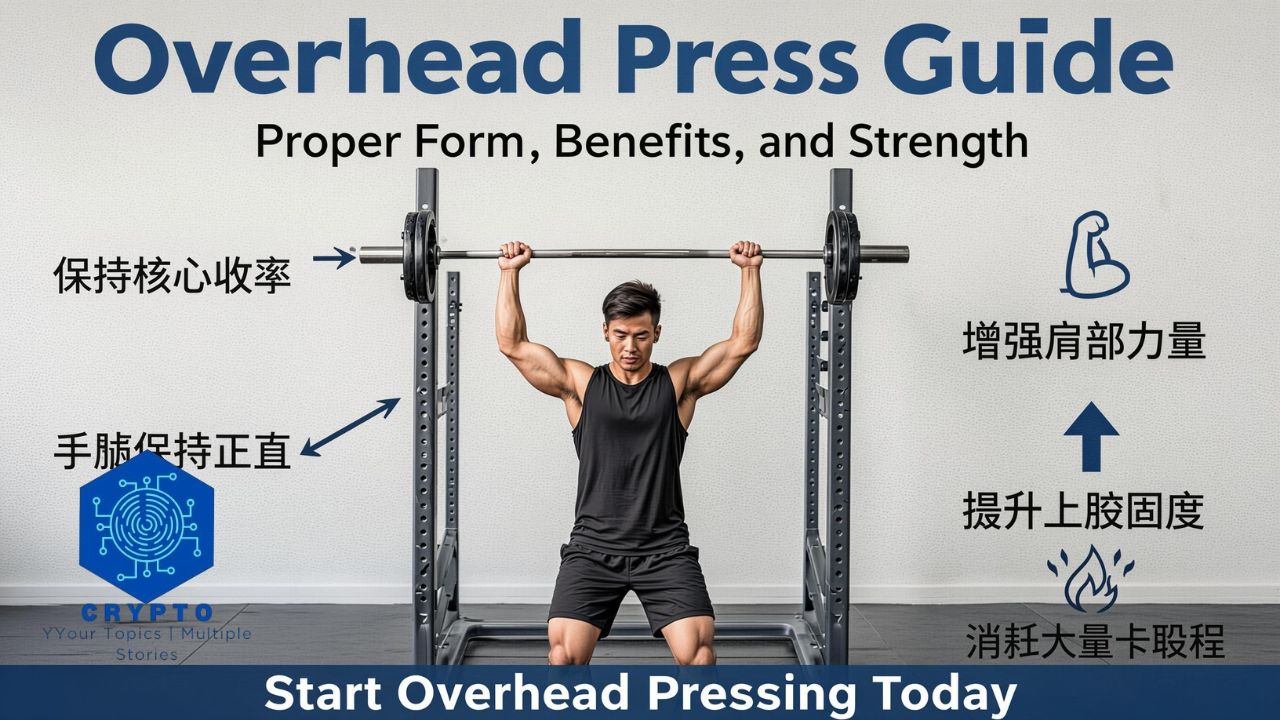
Take a deep breath, brace your core, and press the weight straight up. As the bar passes your forehead, subtly move your head forward so the bar finishes directly over mid-foot.
At the top, arms are locked out, shoulders elevated, and core tight. Lower the weight under control back to the starting position.
overhead press technique improves fastest when lighter loads are used to engrain proper movement patterns.
[Image: overhead press setup and lockout positions]
Common mistakes and how to fix them
Even experienced lifters fall into bad habits.
Excessive lower-back arch
This usually signals weak core engagement or weight that’s too heavy. Squeeze glutes and ribs down before every rep.
Pressing forward instead of vertical
The bar should travel in a straight line. Film your sets from the side to check bar path.
Cutting range of motion
Every rep should start at shoulder height and finish with full elbow lockout. Partial reps limit strength gains.
Variations for different goals
Different variations emphasize different qualities while keeping the core pattern intact.
Barbell overhead press
Best for pure strength development and progression tracking.
Dumbbell overhead press
Improves unilateral balance and shoulder symmetry.
Seated press
Reduces lower-body involvement but increases shoulder isolation.
Push press
Uses leg drive to overload the top portion of the lift, useful for power athletes.
[Infographic: overhead press variations comparison]
Programming and progression
Progress with this lift requires patience.
Recommended rep ranges
- Strength: 3–5 reps
- Hypertrophy: 6–10 reps
- Endurance: 10–15 reps
Weekly frequency
Most lifters respond best to 2 sessions per week, allowing recovery while maintaining skill.
Progress in the overhead press often comes in small jumps. Adding even 2.5 kg can be a meaningful milestone.
Safety, mobility, and recovery
Healthy shoulders are built, not rushed.
Warm-up essentials
- Shoulder CARs
- Thoracic spine mobility drills
- Light band pull-aparts
Recovery tips
Sleep, adequate protein intake, and regular deload weeks protect joints and sustain progress.
FAQs
Is the overhead press safe for beginners?
Yes, when started with light weight and proper coaching.
How often should I train it?
Two times per week works well for most lifters.
Does it build chest muscles?
Indirectly, but chest activation is secondary compared to shoulders and triceps.
Can I replace bench press with it?
They serve different purposes; combining both yields better results.
Why is progress so slow?
Because many stabilizing muscles are involved and adaptation takes time.
Should I use a belt?
Optional—useful at heavier loads but not required for lighter sets.
Is standing better than seated?
Standing develops more total-body stability.
Conclusion
The overhead press rewards consistency, discipline, and respect for technique. It may not deliver rapid ego-boosting numbers, but it builds real strength that carries into daily life and athletic performance. Stick with it, refine your form, and let steady progress do the rest.